Introduction
Learn what ALT Sports Data is, who it serves, and how to navigate the platform.
Introduction
ALT Sports Data helps leagues, sportsbooks, media teams, and developers move alternative sports data through one reliable platform. Instead of every partner handling schedules, results, odds, and market structure differently, ASD delivers a normalized service layer that is easier to integrate and operate.
What is ALT Sports Data?
ASD is both a data service and an integration layer. We ingest league data, normalize it into a shared model, and expose it through APIs, SDKs, and tooling so downstream teams can launch faster.
For leagues, the important question is usually not "what category am I in?" The important questions are:
- What does ASD do for my data?
- How do partners integrate with it?
- How does this help me distribute my events, odds, and markets more reliably?
The platform supports those workflows with:
- API endpoints for sports, events, markets, odds, and futures
- SDKs in TypeScript and Python for faster integration
- MCP tooling so AI agents can query live sports data directly
- Audience-specific guides for sportsbooks, leagues, and media teams
Sport categories and league classification still exist, but they are mainly there to organize the catalog and make the data model consistent across many leagues.
Who these docs are for
- Sportsbooks building event feeds, odds displays, and settlement workflows
- Leagues exploring data partnerships, widget embeds, and sportsbook distribution
- Media teams powering editorial products with real-time odds and event data
- Developers building applications, automations, and internal tooling on top of alternative sports data
- AI agents querying live data through MCP-compatible clients like Claude and Cursor
What you can expect from the API
- A shared data model that works consistently across every sport category
- Production-shaped response examples throughout the documentation
- Audience-specific guides alongside the technical reference
- A clean separation between getting-started content and detailed endpoint docs
Core data model
Most integrations follow the same entity hierarchy:
Category -> Sport -> League -> Event -> Market -> Outcome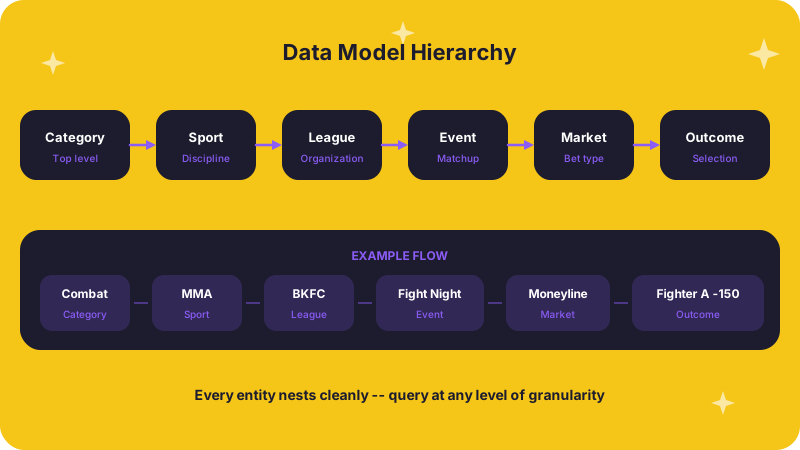
A Category groups related sports (e.g., "Combat Sports"). A Sport is a specific discipline (e.g., "Bare Knuckle Fighting"). A League organizes events under a governing body (e.g., "BKFC"). An Event is a single matchup or competition. A Market represents a bet type on that event (e.g., "Event Winner"). An Outcome is a selectable option within a market, each carrying its own odds.
For the full data model and response format details, see the Platform API Overview.
Response structure
Every successful response returns a data payload and a meta object:
{
  "data": [],
  "meta": {
    "total": 100,
    "page": 1,
    "limit": 100,
    "has_more": false,
    "api_version": "v1",
    "timestamp": "2026-03-07T00:00:00Z"
  }
}
The meta object includes pagination fields so you can reuse the same parsing logic across endpoints. When has_more is true, increment page to retrieve the next batch.
Next steps
- Obtain an API key (or use the demo key
demo-0001) - Make your first real request
- Explore the Platform API Overview for the full data model and response format
- Browse the API Reference for detailed endpoint documentation